

BEV vs HEV vs PHEV vs REEV: Which One Is Right for You?

Understanding the differences between BEV, HEV, PHEV and REEV is now an important first step before buying a new car. All four terms refer to electrified vehicles, but they differ quite a lot in how they work, how they are recharged or refuelled, and how much they cost to maintain. Choosing the wrong one can make a car feel impractical, for example buying a fully electric car when you often travel to areas with few charging facilities.
This article covers a short definition of each type, a side-by-side comparison table, examples of models available in Indonesia, and the pros and cons of each in different driving conditions. At the end, you will also find one thing that is often overlooked: tyre requirements also change depending on the type of vehicle.
Why Are Electrification Terms Becoming More Common in the Indonesian Market?
Over the past two years, the choice of electrified cars in Indonesia has grown rapidly. It is not only fully electric cars; the plug-in hybrid segment has also surged. According to Gaikindo wholesales data, PHEV sales from January to June 2026 reached 5,003 units. Interestingly, this surge happened without government incentives, unlike fully electric cars, which receive a range of tax breaks.
New technologies keep arriving. In April 2026, REEV technology entered the Indonesian market, so car buyers now face four options at once.
Meanwhile, charging infrastructure continues to grow. As of March 2026, PLN and its partners had installed 4,769 public EV charging stations (SPKLU) at 3,097 locations across Indonesia. However, most of these stations are still concentrated on the island of Java. This is why understanding the differences between each type of electrified vehicle is becoming increasingly relevant.
Short Definitions of BEV, HEV, PHEV and REEV
Before getting into the comparison, here is a brief explanation of each term. Each paragraph can be read on its own, depending on the type of vehicle you are considering.
What Is a BEV?
A BEV, or Battery Electric Vehicle, is a fully electric car powered entirely by an electric motor using energy from a battery. This type of car has no petrol engine at all, so it produces no tailpipe emissions while driving. The battery is recharged using a home charger or a public charging station (SPKLU), and its driving range depends heavily on battery capacity.
What Is a Hybrid Car?
A hybrid car combines a petrol engine and an electric motor to drive the wheels, either alternately or at the same time. The most common type is called an HEV, or Hybrid Electric Vehicle. Its battery is small and does not need to be charged externally, because it is recharged automatically by the engine and by energy recovered during braking (regenerative braking). For the driver, it is used exactly like a regular petrol car.
What Is a Plug-in Hybrid?
A plug-in hybrid, or PHEV (Plug-in Hybrid Electric Vehicle), is a development of the HEV with a much larger battery that can be recharged from an external power source. A PHEV can run in pure electric mode for tens of kilometres, which is enough for many daily routes. When the battery runs low, the petrol engine also drives the wheels, so the car can still cover long distances without having to look for a charging station.
What Is a REEV?
A REEV, or Range-Extended Electric Vehicle, is a car whose wheels are always driven by an electric motor, while its petrol engine acts only as a generator. This engine is called the range extender, a device that generates electricity to recharge the battery when its charge starts to drop. Because the wheels are never driven directly by the engine, the driving experience feels very similar to a fully electric car. The battery can still be charged externally, just like a BEV.
The Range Extender Is the Key Difference Between PHEV and REEV
At first glance, PHEVs and REEVs look similar because both have a large battery and a petrol engine. The difference lies in the role of the engine. In a PHEV, the petrol engine also turns the wheels. In a REEV, the petrol engine never drives the wheels and only produces electricity. Because the engine speed does not need to rise and fall with the accelerator pedal, the engine can run in its most efficient range, so fuel consumption and emissions are better controlled than in a conventional car.
BEV, HEV, PHEV and REEV Comparison Table
To make things easier to understand, here is a summary of the differences between BEV, HEV, PHEV and REEV across four key aspects.
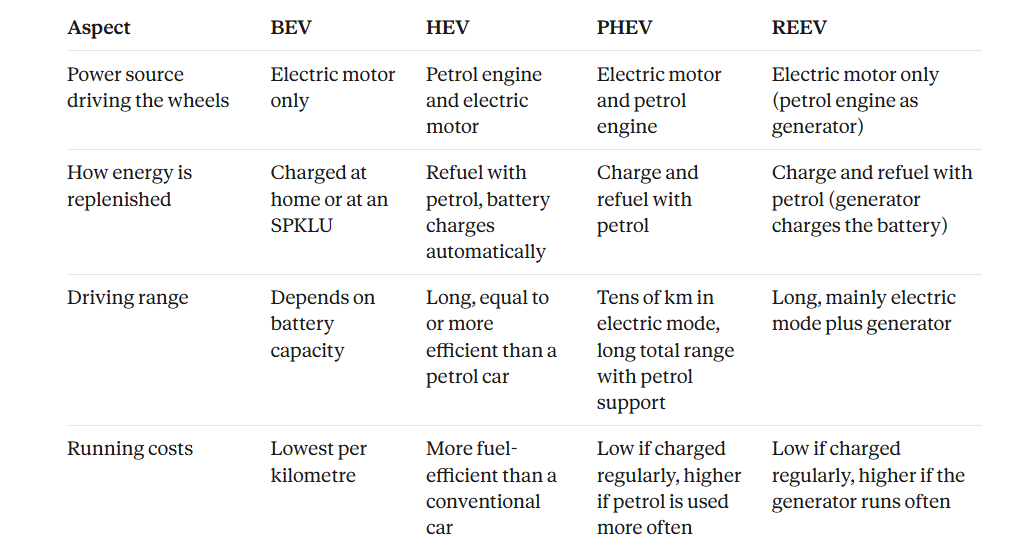
One thing to note: the efficiency figures of PHEVs and REEVs depend heavily on the owner's habits. A car that is rarely charged will rely more on petrol, which reduces its efficiency advantage.
Example Models in Each Category Sold in Indonesia
Model line-ups keep changing as new cars are launched, so treat the list below as a starting point before checking availability at a dealer.
BEV Examples
BEV models on sale in Indonesia include the Hyundai Ioniq 5, Wuling Air ev, Chery J6 and the BEV version of the Changan Deepal S05.
HEV Examples
The hybrid segment is dominated by family cars and SUVs, such as the Toyota Kijang Innova Zenix Hybrid, Toyota Yaris Cross Hybrid, Mitsubishi Xforce HEV and MG ZS Hybrid+.
PHEV Examples
For plug-in hybrids, popular models include the BYD M6 DM, Chery Tiggo 8 CSH, Wuling Eksion PHEV and Toyota RAV4 PHEV. Of these, the BYD M6 DM was recorded as the best-selling PHEV model through mid-2026.
REEV Examples
REEV options in Indonesia are still very limited. One model already on sale is the Changan Deepal S05 REEV, which is also available as a BEV, so the two can be compared directly.
Pros and Cons of Each Type by Driving Condition
The advantages of each technology become clear when matched to how you use your car. Here is an overview of the pros and cons in the three most common scenarios.
For Daily City Driving
BEVs are the best choice for predictable daily routes, especially if you can charge at home. Energy costs are low, the cabin is quiet, and acceleration is responsive in heavy traffic. The downside is that you need to be disciplined about scheduling your charging.
PHEVs and REEVs are also very efficient in the city as long as the battery is charged regularly, because most daily trips can be covered in electric mode. HEVs remain economical in traffic jams because the electric motor does much of the work at low speeds, although their fuel consumption is not as low as the other three types.
For Out-of-Town Trips
HEVs are the most practical choice for long trips because you only need to fill up at a petrol station, with no need to plan charging stops. PHEVs and REEVs offer an attractive combination: electric mode at the start of the journey, then petrol as a backup, so range anxiety is almost non-existent.
BEVs can still be relied on for out-of-town trips, especially on toll roads where many rest areas already have charging stations. However, you need to factor in charging time and possible queues during the holiday season.
For Areas with Limited Charging Stations
In areas where charging facilities are still scarce, HEVs are the safest option because they do not depend on external electricity at all. REEVs and PHEVs are also fairly safe because they can still run on petrol, although their efficiency drops if they are rarely charged.
BEVs are the most challenging choice in these conditions. A fully electric car can still be used if you have a home charger and your daily route does not exceed the battery's range, but intercity trips require extra planning.
How to Choose an Electrified Car Based on Your Driving Pattern and Budget
Once you understand the differences between BEV, HEV, PHEV and REEV, the next step is to match them to your habits and financial situation. The following questions can help narrow down your options.
Consider Your Access to Charging
If you can install a charger at home, BEVs, PHEVs and REEVs are all worth considering. Without regular access to charging, an HEV makes much more sense, because the advantages of a PHEV or REEV would go unused.
Calculate Your Daily Distance and How Often You Travel Long Distances
Drivers with short daily routes who rarely leave the city will benefit most from a BEV. If you often travel long distances or make homecoming trips to areas with limited charging stations, a PHEV, REEV or HEV offers greater flexibility.
Match It to Your Total Cost of Ownership
Do not look at the purchase price alone. Also calculate monthly energy costs, taxes, routine maintenance and resale value. BEVs generally win on energy and maintenance costs because they have fewer moving parts, while HEVs offer a relatively affordable starting price with a familiar maintenance routine.
Think About How Ready You Are to Adapt
If this is your first move to an electrified vehicle, an HEV is the easiest transition. PHEVs and REEVs can serve as a bridge to a fully electric car, because you get used to charging without losing the reassurance of a petrol engine.
Do Tyre Requirements Differ Between Types of Electrified Vehicles?
Many owners focus on the battery and the engine, yet tyres are the only component in direct contact with the road. The characteristics of electrified vehicles place new demands on tyres, and the level of demand differs for each type. You can read a more detailed discussion in the article Are Electric Car Tyres Different from Regular Tyres?
Vehicle Weight
Large-capacity batteries make BEVs, PHEVs and REEVs heavier than petrol cars in the same class. PHEVs and REEVs even carry two systems at once: a large battery and a petrol engine. Tyres for vehicles like these need a sturdy structure and a suitable load index to stay stable and avoid wearing out quickly. HEVs, with their small batteries, weigh roughly the same as conventional cars.
Instant Torque
Electric motors deliver maximum torque from the very start of acceleration. This is felt most in BEVs and REEVs, whose wheels are always driven by an electric motor. Tyres need good grip and a compound that can withstand strong twisting forces so they do not wear out too quickly.
Efficiency and Noise
Tyre rolling resistance has a direct effect on the range of electric cars and the fuel consumption of hybrid cars. The lower the rolling resistance, the less energy is wasted. In addition, the quiet cabins of electrified vehicles make tyre noise easier to hear, so low-noise tyres feel more comfortable. You can find tips on choosing the right product in the article Signs of a Good Tyre Brand for EVs.
FAQ: Differences Between BEV, HEV, PHEV and REEV
Do hybrid cars need to be charged?
Not HEVs. Their battery is charged automatically by the petrol engine and regenerative braking. External charging is only needed for plug-in hybrids (PHEVs).
Is a REEV considered an electric car?
In terms of how it works, a REEV is a car whose wheels are always driven by an electric motor, so the driving experience is equivalent to an electric car. However, a REEV still needs petrol to run its generator, which sets it apart from a BEV, which is completely fuel-free.
Which is more economical, an electric car or a hybrid?
In terms of energy cost per kilometre, fully electric cars are generally more economical. However, hybrid cars are more practical for drivers without regular access to charging, and they tend to be cheaper to buy.
What is the difference between a PHEV and a REEV if both have a battery and a petrol engine?
In a PHEV, the petrol engine also drives the wheels. In a REEV, the petrol engine only serves as a range extender that produces electricity for the battery, while the wheels are always driven by the electric motor.
Can electric car tyres be used on a hybrid car?
Yes, as long as the size, load index and speed index match the vehicle's specifications. Tyres designed to be EV-ready actually bring extra benefits to hybrid cars, such as low rolling resistance and a quieter cabin.
Conclusion
The differences between BEV, HEV, PHEV and REEV basically come down to the roles of the electric motor and the petrol engine, and how each type replenishes its energy. BEVs are the most efficient for drivers with good access to charging, HEVs are the most practical with no need to change your habits, while PHEVs and REEVs offer an electric driving experience with petrol as a backup for long trips. The best choice depends on your driving pattern, access to charging in your area, and your total cost of ownership budget.
Whichever type of electrified vehicle you choose, make sure its tyres can keep up with the vehicle's weight, torque and efficiency needs. DUNLOP Blue Response TG features an EV Ready concept, which means its construction is designed to support heavier vehicles, handle instant torque, and stay efficient and quiet. That makes it suitable not only for electric cars, but also for hybrid and conventional cars. Blue Response TG is available in 34 sizes with rim diameters from 15 to 19 inches, and comes with a SmartCare Warranty for 1 year or 24,000 km, subject to terms and conditions.
Once you have found the electrified vehicle that suits you best, complete your choice with the right tyres. Visit your nearest DUNLOP Shop and consult our team about your vehicle's tyre needs.